
In 2016, KNUST mathematician Dr. Yao Elikem Ayekple contributed to research that provides a mathematical way to predict outcomes in systems that behave randomly but are constrained by defined limits.
Working with colleagues, he applied a matrix-based approach to answer questions such as: How long will a process continue before it stops? What is the likelihood of ending at a particular point? And how often will a system reverse direction instead of settling?
The study showed that once a key tool, known as the “fundamental matrix”, is calculated, these outcomes can be determined systematically.
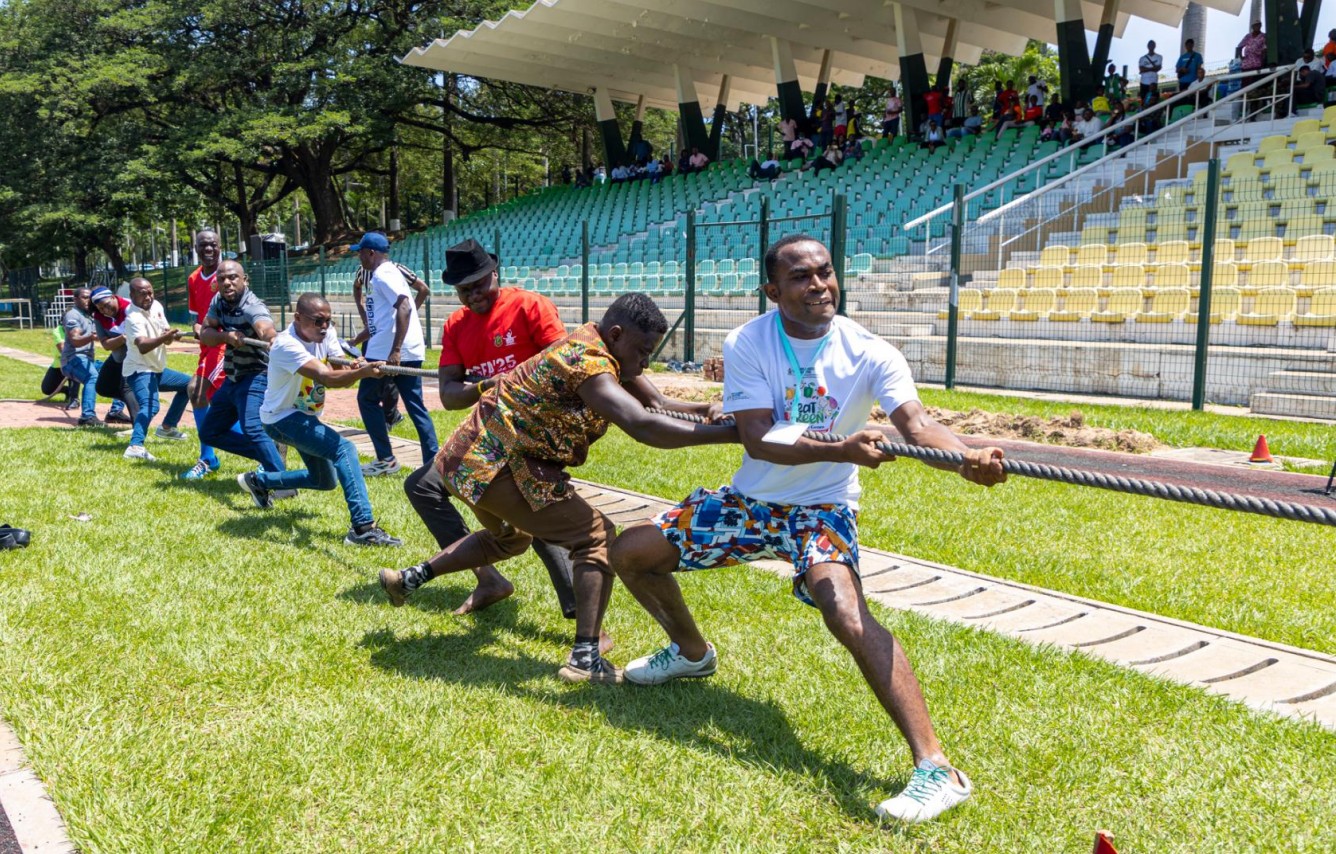
That logic appeared to echo, albeit in a lighter, more playful way, during the 2026 Convocation Fun Games tug-of-war contest between the Ghana Association of University Administrators (GAUA) and the University Teachers Association of Ghana (UTAG).
With both teams having won once each at the Ayigya end, a tie-breaker was needed at the Paa Joe Stadium. A coin toss was used to determine direction.
Dr. Ayekple insisted that the coin be tossed on a flat surface rather than on grass.
“The plain ground ensures fairness,” he explained to me.
Well, a flat surface does not change the probability of a coin toss, but it reduces irregular bounces and potential disputes, making the outcome easier to accept.
UTAG won the toss and secured the Ayigya direction, an end that had already proven advantageous.
But beyond chance, tug of war is decided by strength, technique and endurance.
Amankwah and Akeale: grips and footing
An observation of posture across both teams showed that most participants adopted the recommended backward lean, lowering their centre of gravity to maximise pulling force.
After GAUA's Dr. Adeline Angkosaala, told me her left arm is dominant, some of the GAUA members said otherwise. It was the same mix on the UTAG side.
However, one variation stood out.
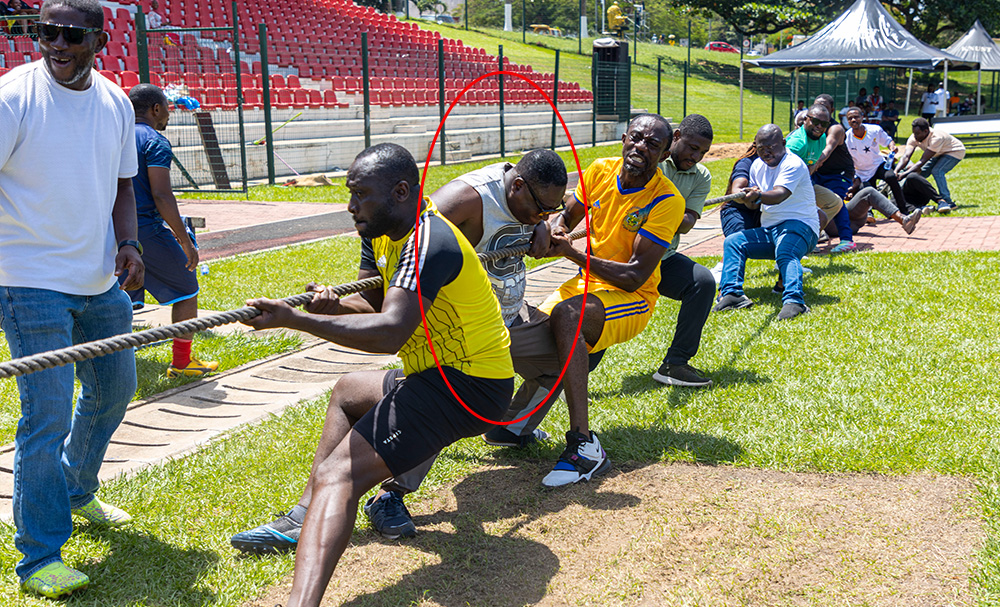
Prof. Emmanuel Adu Amankwah used a body-clamp grip, holding the rope close to his torso with bent arms. While this can provide short-term stability, it is generally less effective. The position reduces pulling distance and limits the transfer of force from the legs and back, relying more on arm strength than full-body coordination. By contrast, teammates with extended arms and a pronounced backward lean were better positioned to generate sustained pulling force.
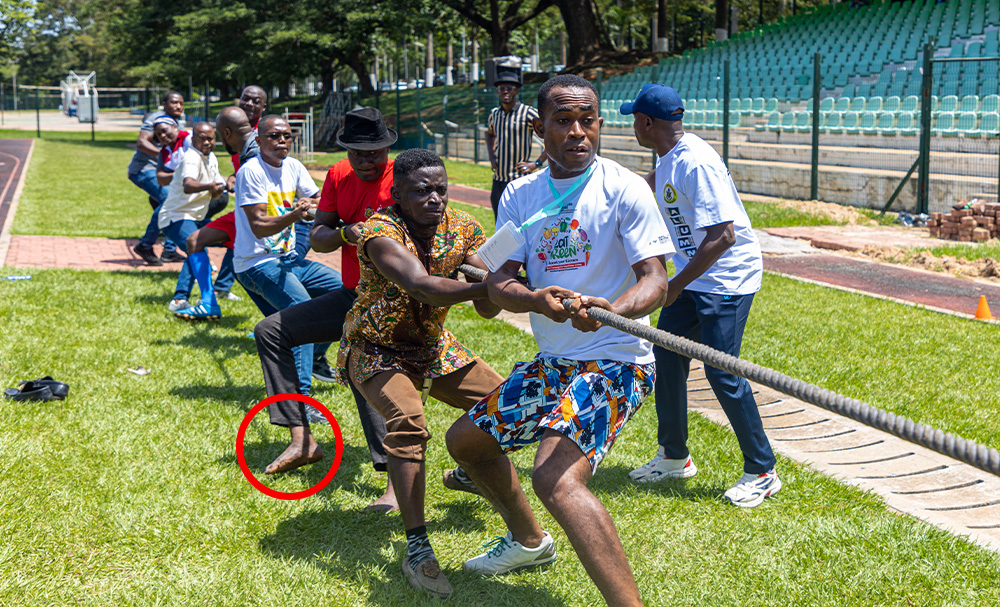
Foot grip also came into focus. On the GAUA side, Alex Akwasi Akeale Weyeamo-Kubati competed barefoot while others wore trainers.
Contrary to common assumption, barefoot traction on grass is not necessarily worse. Bare feet can increase friction through direct contact with the ground, while toes spread naturally to improve balance and grip. Trainers, especially those with flat soles, can slip on grass surfaces if they do not provide sufficient traction.
Sports biomechanics research shows that grip depends largely on the interaction between footwear and surface. Flat-soled trainers generally perform less effectively on grass compared to studded shoes, which are designed to penetrate the surface and improve stability.

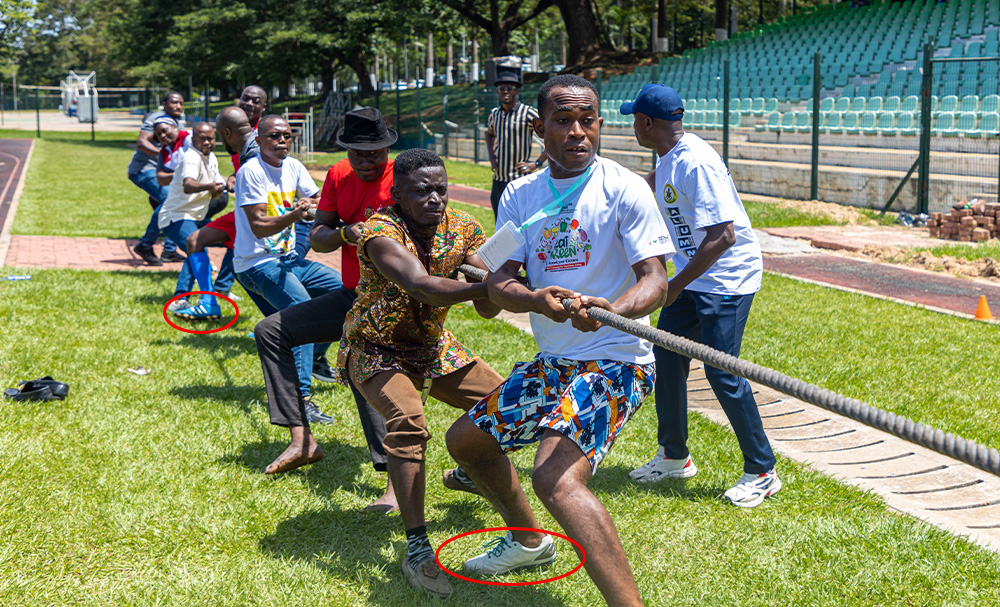
Both teams had a mix of footwear, including two participants on each side wearing studs.
However, subtle differences may have mattered. On the GAUA side, both participants in studs were firmly positioned on grass, while on the UTAG side, only one studded participant had full contact with the grass, with the other partly on a harder surface. This could have influenced traction and stability.
The question of direction also lingers. If most participants are right-handed or right-leg dominant, pulling direction can affect how effectively they anchor and generate force, though this often depends more on team coordination than handedness alone.
To better understand the outcome, Prof. Moses Sunday of the Department of Physiotherapy and Sports Science offered a scientific perspective.
“Winning in tug of war demands a coordinated scientific approach,” he said. “You must consider posture, foot grip, dominant limbs, and the synchronization of the team. The timing of when to pull and how to extend the body is also critical.”
In the final tie-breaking round, which lasted about 30 seconds, GAUA were unable to sustain their hold.
In the end, the result may not have been decided by the coin toss alone, but by a combination of marginal gains, including technique, traction, coordination and endurance, where even small differences can determine who yields first.
| Story: Emmanuel Kwasi Debrah | Photos: Isaac Kwaku Duah |


